


The fog came back this week. It rolls up from the valley in the morning and settles in the olive trees until almost noon, and by the time we’ve fed the dogs, Charlie and the four Paulettes, the whole Quinta smells of wet earth and woodsmoke. Every year, the same signal. The light gets shorter, the land goes quiet, and the dead come closer.
I don’t say that to sound spooky. I say it because almost every people on this planet noticed the same thing at this time of year, and almost every one of them answered it the same way: they set the table.
In Mexico, for Día de Muertos (you’ll also hear Día de los Muertos), that table is the ofrenda. And on it, between the marigolds, the candles, the bread and the photos, you’ll almost always find chocolate.
🍫 Where does the word "chocolate" come from?
Nobody knows for sure, and I like that.
The Spanish stitched together the Yucatec Maya chokol, "hot", and the Nahuatl atl, "water". Chokol-atl, hot water, because the Maya drank their cacao warm. (Mexican scholar Francisco Santamaría proposed it, and Sophie and Michael Coe, authors of The True History of Chocolate, agreed.)
Other linguists lean towards the Nahuatl chicolatl, "beaten drink", from chicolli, the little frothing stick, an old cousin of the molinillo.
And the famous xocolatl, "bitter water", that you'll read everywhere? It has never been found in any early text.
Cacao is older still: the Maya painted it as ka-ka-wa in glyphs on their drinking cups, a word they probably received from their Mixe-Zoque neighbours.
Let’s talk about why. And then, let’s talk about your table.
The oldest cup on the altar
Long before there was a Día de Muertos, there was cacao in the graves.
Most of what we know about how the ancient Maya used cacao comes from their tombs. At Copán, in what is now Honduras, archaeologists found burial vessels from the Early Classic period (roughly 400 to 600 AD) that still held traces of cacao: a little deer-shaped bowl that probably held ground cacao, a painted cup that likely held the frothy drink. The cups were placed beside the dead so they wouldn’t go hungry or thirsty behind the veil.
And it goes further than food. On a king’s sarcophagus at Palenque, in southern Mexico, his dead mother is carved as a cacao tree, pods growing from her body.
The ancestor becomes the tree. The tree feeds the living. The living feed the dead. Round and round.
That image stayed with me for a long time, and it ended up shaping one of my guided cacao journeys, where the spirit of cacao walks you towards your ancestors
→ Journey With The Spirit Of Cacao To Meet Your Ancestors.
The Mexica (the people we often call Aztecs) carried this on in their own way. In their ritual speech, cacao was spoken of as heart and blood. The drink was life itself, which is exactly why it belonged to the gods and to the dead.
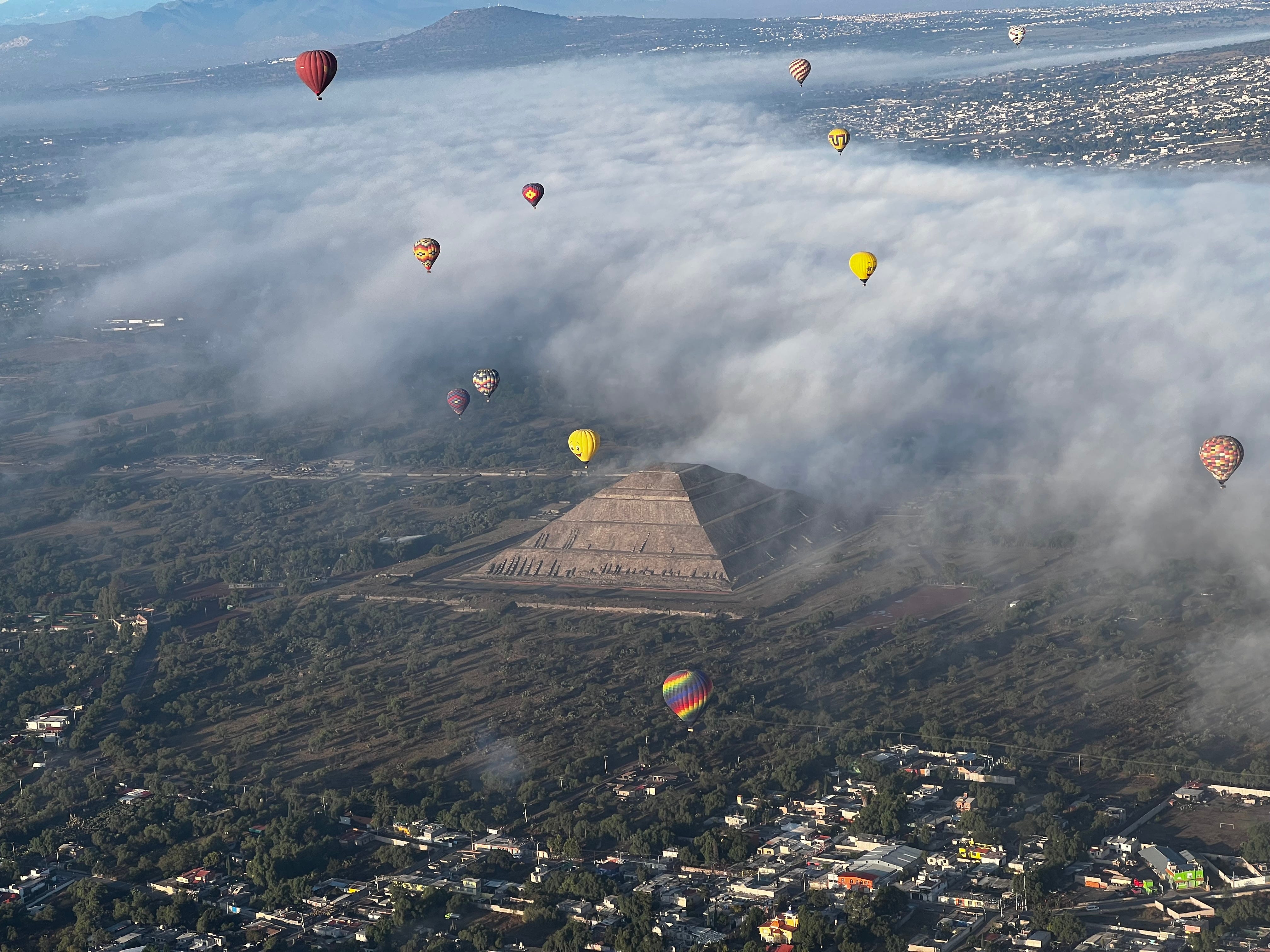
When I travelled to Mexico in 2023, to Teotihuacan and Tepoztlán, cacao was everywhere. In the markets, in the cups, and in the museums too, where wooden molinillos several centuries old rest behind glass, the little whisks that have been frothing chocolate for generations, next to the stone metates that ground the beans long before them.
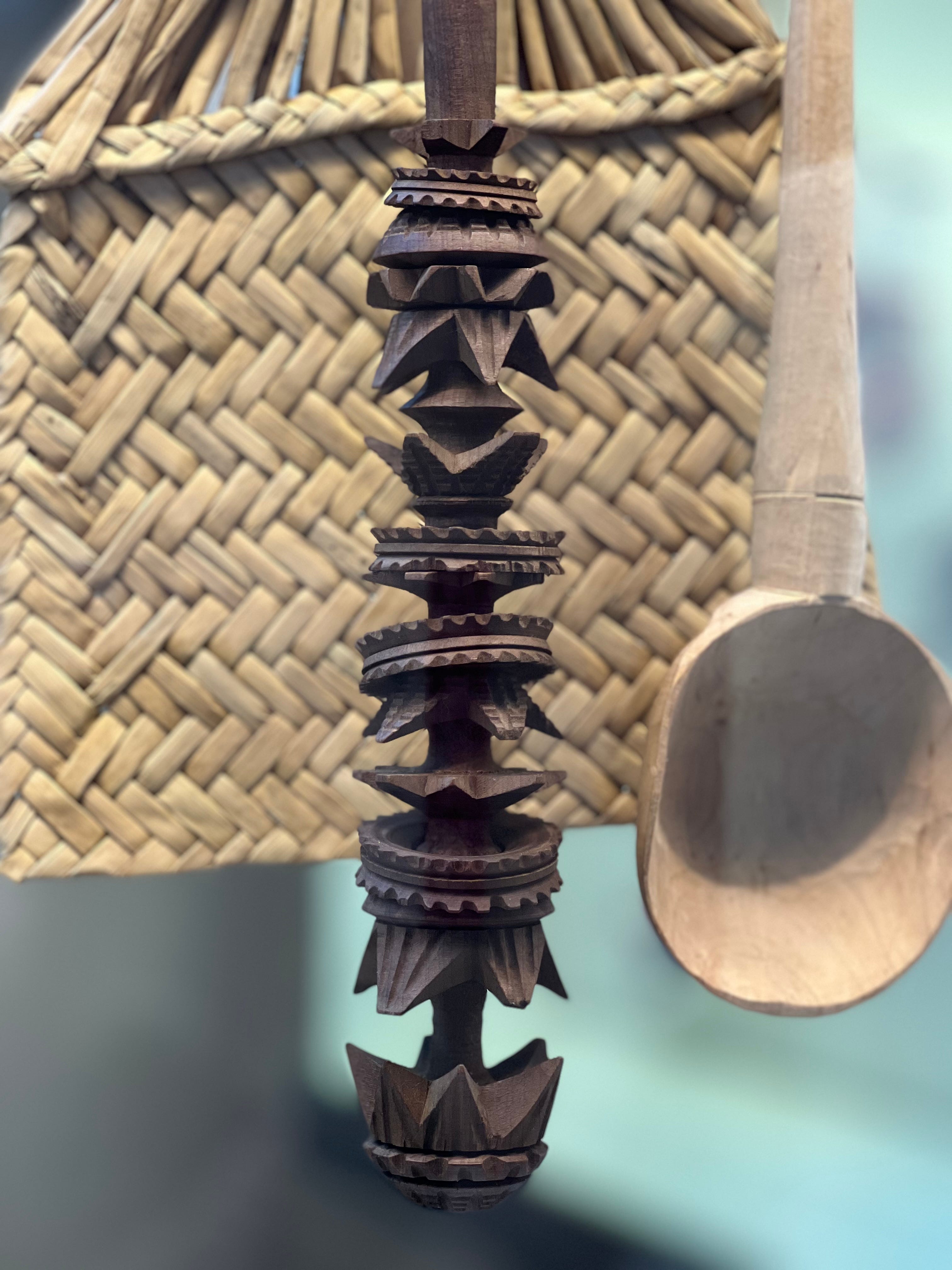
So when a family in Oaxaca whisks a pot of chocolate for their grandmother on the night of the 1st of November, they aren’t decorating. They’re carrying on a conversation with their dead that is at least fifteen centuries old.
What sits on the ofrenda today
Today’s Día de Muertos weaves those Indigenous roots together with the Catholic days of All Saints (1 November) and All Souls (2 November). The ofrenda holds water for the long journey, bread, salt, candles, the cempasúchil marigolds whose petals trace a path from the door to the altar, and the favourite foods and drinks of the person being remembered.
Cacao arrives in many shapes: chocolate de agua, made with water, champurrado (a thick corn drink with chocolate), mole, little skulls made of chocolate. In some Oaxacan families, the hot chocolate and bread keep going for eight days, until the night they call the octavo, when the flowers have dried and the altar comes down.
In 2023, just behind the wall that closes off the pyramids of Teotihuacan, I was welcomed into the home of an elder, on the land of her own ancestors. At her door, an altar ran along the ground, about seven metres long and a metre and a half wide. Everything was there: the skulls, the clay figures, the candles, the flowers, and a little further along, dried cacao pods. We shared a temazcal with her that day, one I will never forget. This photo is only one small corner of it.
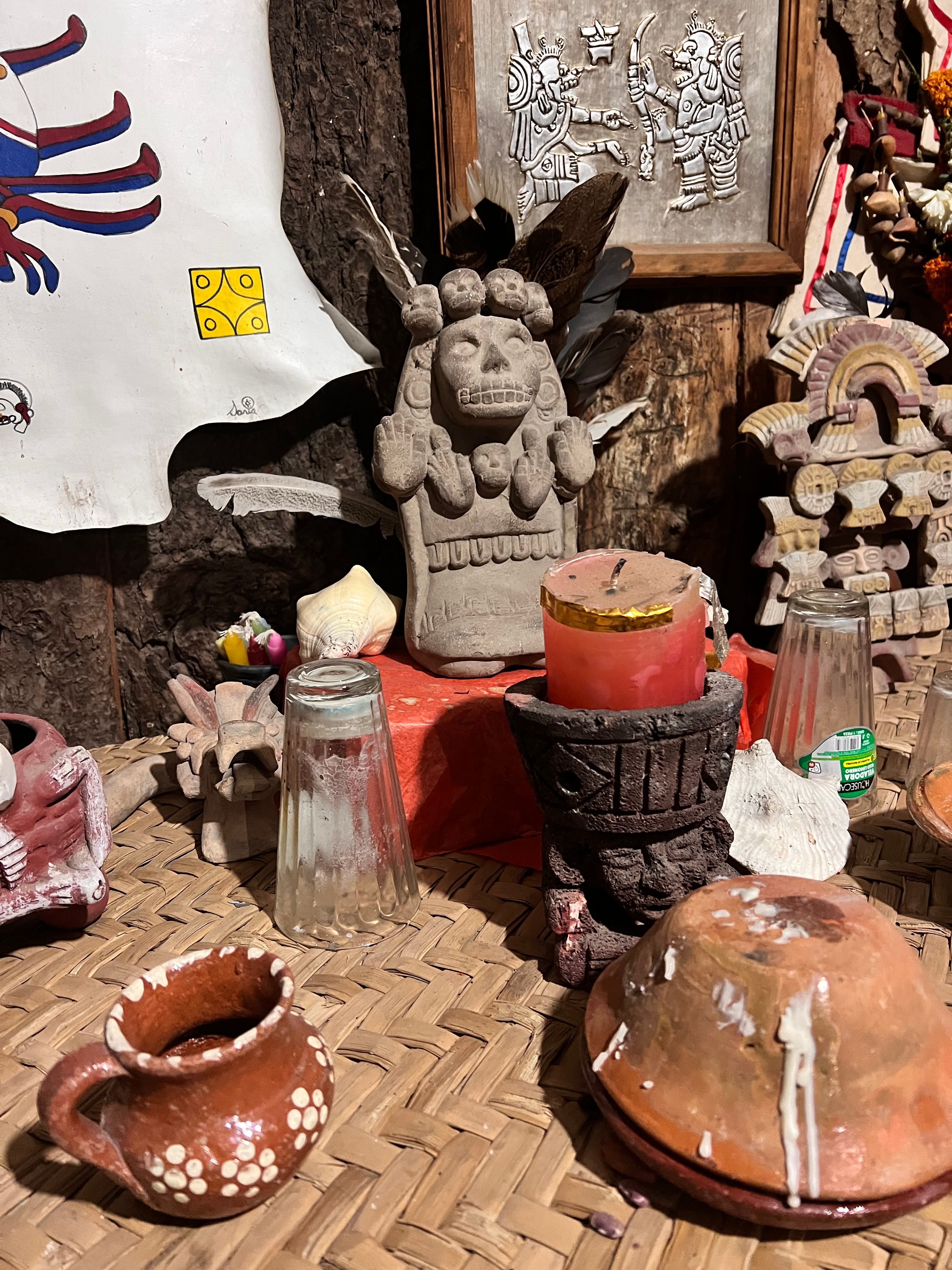
And then the living eat. That’s the part I love most. The dead take the essence, the scent, the steam rising from the cup, and the family shares what’s left. Nothing wasted. Nobody forgotten.
Please don’t borrow the party
I want to be honest with you on this one.
In the last few years, the Day of the Dead has become a look. Painted faces, sugar skulls on T-shirts, “ofrenda aesthetic” moodboards. Some of it comes from real love. A lot of it is a culture worn like a costume, with its dead left out of the picture.
I work with a plant that comes from the Maya lands and the peoples of Mesoamerica. Every cup I share exists because those peoples kept cacao alive through centuries of conquest and erasure. So I try to walk carefully.
My honest answer to “can I celebrate Día de Muertos if I’m not Mexican?” goes like this: you can learn about it, honour it, visit with respect if you’re invited, and buy your bread and chocolate from the families who make them. But you don’t need to borrow it to feed your own dead.
Because your people had a table too.
→ Read: Ancestors: Who Are They, Really?
What your own lineage put on the table
You might think your family has nothing like this. Look again, a few generations back.
I grew up in Guadeloupe, until I was thirteen, and la Toussaint over there looks nothing like the grey, chrysanthemum-heavy day you might picture in mainland France. At nightfall the cemeteries fill up. Thousands of candles glow on the family tombs, and people stay late with their dead, talking, eating, laughing. And everyone honours them in their own way: Caribbean families, Indian families, families of African descent, each keeping their own ancestral rituals, side by side in the same candlelight. That’s where I first learned that the dead are family, not ghosts.
Europe has its older layers too, if you scratch the surface. In Brittany, on the Night of the Dead, families used to cover the kitchen table with a white cloth and leave out hot pancakes, curds and cider for the Anaon, the souls of the ancestors, with a log kept burning in the hearth so they could warm themselves through the night. In Corsica, before going to bed, people would set bread and water, or milk and chestnuts, on the table or the windowsill, because the dead were said to come back to the houses they’d lived in.
And Portugal, where I spent four of my teenage years in Cascais and our home again today, has its own. On the 1st of November, children in some villages still go door to door calling “Pão-por-Deus!” and come home with bread, nuts, pomegranates and chestnuts in a little cloth bag. These traditions still carry on, especially in the countryside. In the older tellings, those gifts were bound up with prayers for the souls of the dead. The next day, Dia dos Fiéis Defuntos, the cemeteries fill with flowers and candles. A few days later comes the Magusto, chestnuts roasting on the fire, the whole village gathered around it. (i will talk about it soon 🌰).
It’s one of the things I love most about this country. Portugal is very Catholic, and yet the old rites, the pagan ones, the Celtic ones, the ones nobody can quite date anymore, never really left. They just put on a church coat and carried on. And that matters, because those rites are how our ancestors get fed. They need us as much as we need them.
Bread. Milk. Chestnuts. Cider. Candles on a tomb. A clean cloth on the table. Different foods, the same gesture: you’re still part of this house, come and eat.
So this is my invitation for you this year. Before you reach for someone else’s altar, ask the elders in your family. Ask what their grandparents did in November. What was cooked, what was left out, whose names were spoken. You might be surprised by how much is still lying around, waiting to be picked up.
A cup for your dead
First, a little secret: it doesn’t have to be cacao. If your grandfather never started a day without strong black coffee, if your grandmother loved her tea, or her small glass of rum on Sundays, give them that. The point is to feed them what they loved. Hot or cold, it doesn’t matter.
On my own altar, it’s mostly my dad I honour. His photo, a candle, and some tobacco or a cigarette, because that’s what he’d ask for. The rest of the altar belongs to the ancestors of this land and of my lineage as a whole.
And in my own cacao journeys, all year round, I always pour one cup that goes only to the ancestors’ altar. It’s simply part of how I work with this plant.
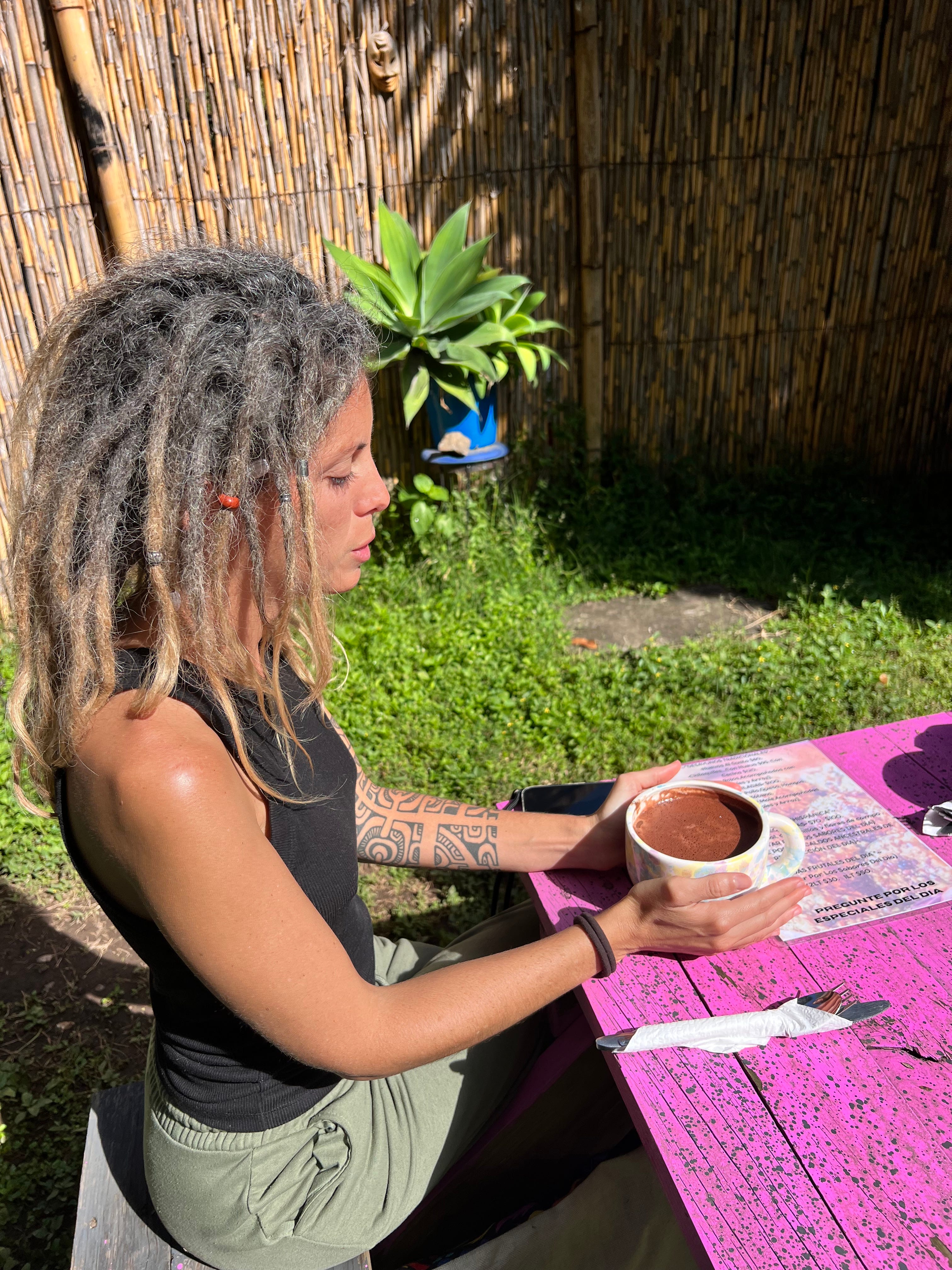
So if you’d like cacao to be part of it, because it’s the plant you walk with, because it opened your heart, or simply because it’s what you have in the cupboard, you can offer it to your own ancestors in a way that honours where it comes from. It doesn’t take much.
Prepare a cup of pure ceremonial cacao. Just cacao and hot water, no milk, no sugar. Make it the way your hands know.
Set a small space. A candle, a photo or a name written on paper, and a few seasonal things from your land. Go outside to pick them up. Intention matters. A chestnut. A pomegranate. A sprig of rosemary.
Pour the first share for them. Before you drink, fill a separate little cup. That first share is theirs.
Say their names out loud. All the ones you know. Then, for all the others: “And to all of you whose names were lost.” Write it if you are unable to speak.
Talk to them a little. Tell them what’s happening in your life. Thank them for what came down to you, and if some of it was heavy, you can say that too. Be grateful first for what you have.
Thank the cacao, and the Maya and Mesoamerican peoples who kept this medicine alive and still walk with it today.
Leave their cup on the altar for about a day. After roughly 24 hours, give it back to the earth, at the foot of a tree if you have one. We don’t let offerings go mouldy: once they’ve taken what they needed, it returns to the soil.
A little prayer, if you’d like words to start with:
Grandmothers, grandfathers, all of you who walked before me,
this cup is for you.
Cacao from the hands of the Maya, warm from my kitchen.
Drink, rest, warm yourselves by my fire.
I carry you. I remember you.
May what was heavy grow lighter in me,
and may what was good keep growing through me.
Then drink your own cup, slowly, in their company.
That’s all. No costume needed. A table, a cup, and the people you came from.
If you’d like to give them a more lasting place at home, I wrote about why an ancestor altar matters and how to begin one :
→ Read: The Ancestor Altar: Why Create One and How to Begin
Pass the credit on
One last thing, and it matters to me. If you share this practice, with friends, in your own work, on social media, please name where cacao comes from. Not “an ancient tradition”. Not “a ritual I made up”. The Maya. The Mexica. The peoples of Mesoamerica, who are still alive, still growing it, still keeping their dead fed.
And if it’s another tradition that catches your eye, one of those suddenly everywhere, do the same. Find out whose it is, and say their name.
Pass the credit on with the cup. That’s how we receive without taking.
If you’d like a few words to carry into your November, I’ve recorded a short set of affirmations to honour your ancestral lineage on Insight Timer.
→ Affirmations To Honour Your Ancestral Lineage
On the 1st and 2nd of November, I’ll light a candle at the Quinta and set a cup on our little altar. If you light one too, tell me in the comments who you’re remembering. I’d love to hold their names with you. 🕯️
Blessings,
Johanna 🤎
🪶 Stay close: Instagram · Insight Timer · WhatsApp group (early access to events and stays at the Quinta)